October 18 @ 19:00 – 20:30
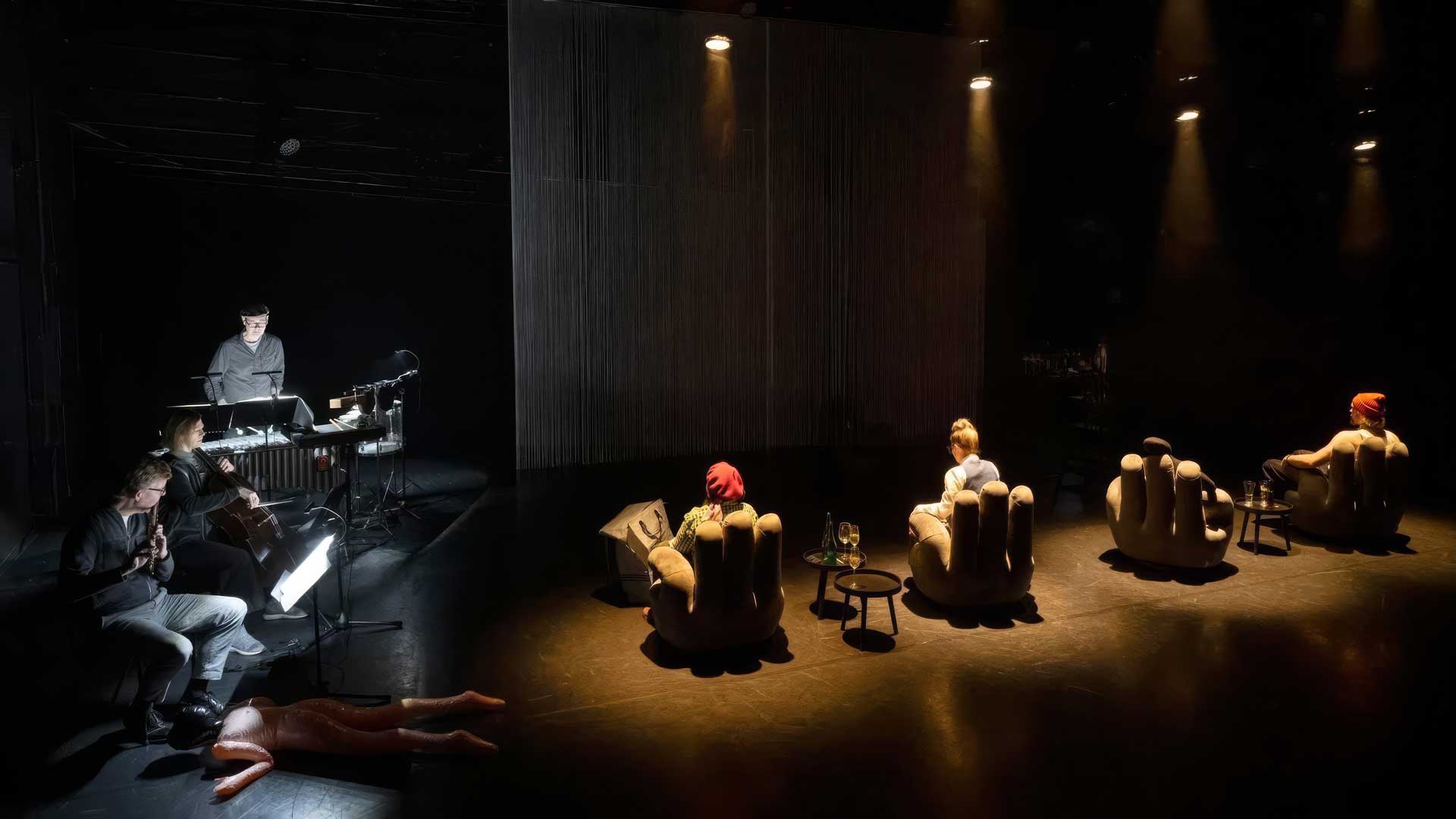
At this concert, part of the Göteborg International Organ Festival, Gageego! and the opera company Man Must Sing take on three of the most distinctive composers of the post-war era: Giacinto Scelsi, György Ligeti and Sofia Gubaidulina.
The music dates from the 1960s and 70s, yet each piece, in its own way, breaks with the notion of the tone as a neutral building block of musical language.
In Scelsi, the single tone is opened from within, becoming a space of shifting colours, movements and resonances. In Ligeti, attention shifts to the human voice and body: a language before words, in which laughter, cries, whispers and gestures form an absurd and at times unsettling music theatre. In Gubaidulina, the encounter between organ and percussion becomes a dialogue between different material and sounding bodies.
Throughout the programme the organ is a distinctive presence: alone in Scelsi, embedded in the ensemble in Ligeti, and finally set against the percussion in Gubaidulina. Ultimately, the concert is about something more fundamental still: the moment when a sound ceases to be merely a tone and begins to emerge as gesture, space and action – music that does not simply shape sound, but listens for what is already moving within it. The music we hear tonight is kaleidoscopic, though in three quite distinct ways.
Programme
Giacinto Scelsi Pranam II
György Ligeti Aventures
Giacinto Scelsi In nomine lucis
György Ligeti Nouvelles Aventures
Sofia Gubaidulina Detto I
Giacinto Scelsi: Pranam II (1973)
From the 1950s onwards, the Italian composer Giacinto Scelsi (1905–1988) increasingly turned his attention to the single tone and what he himself repeatedly referred to as its inner life. In Pranam II the ensemble circles a restricted pitch material that gradually opens up through timbre, microtonal inflection, intensity and resonance. Together, the instruments seem to illuminate one and the same sounding body from different angles. The music’s motion therefore unfolds as much within the sound as between sounds: something emerges, thickens, shifts and withdraws.
György Ligeti: Aventures (1962)
During the 1960s, the Hungarian-Austrian composer György Ligeti (1923–2006) sought musical forms beyond traditional melody and harmony. In Aventures he abandons language as well, yet retains the human being as a speaking creature. Three singers are tossed between laughter, whispers, cries, weeping and absurd conversations in a language that does not exist. Voices and instruments form an imaginary theatre in which situations arise without ever being explained. What remains is the body of language – its affects and social games – freed from the demands of unambiguous meaning.
Giacinto Scelsi: In nomine lucis (1974)
As already noted, Scelsi’s late music revolves around a handful of pitches and the worlds that can open up within their inner life. In In nomine lucis the organ is transformed into a suggestive, resonant space. Tones are sustained and altered through tender, meticulous registration, the stops slowly drawn in and out to create an unstable and mysterious sound world. What may at times seem motionless gradually becomes ever more vibrant. The title – in the name of light – also offers a fitting way into the work, as a slow widening and enveloping of light; tonight, however, this takes place strictly in the realm of sound. What does light sound like? Scelsi offers us an answer.
György Ligeti: Nouvelles Aventures (1962–65)
Ligeti’s music often combines – as we will already have heard this evening – an almost microscopic precision with a keen sense of the absurd. Nouvelles Aventures continues the strange theatre begun in Aventures: three voices, a small instrumental world and a language without words. Here the affects seem to lead lives of their own, detached from the narratives that normally explain them. Rage may turn into tenderness, laughter into fear, a whisper into a collective outburst. Ligeti composes a narrative of bodies, sounds and gestures. What it tells can never be put into words, only heard – but a new adventure (in the widest possible sense of the word) awaits us tonight all the same.
Sofia Gubaidulina: Detto I (1978)
During the Soviet era, Sofia Gubaidulina (1931–2025) developed a strongly personal musical language in which the music carries – indeed must carry! – an existential and spiritual charge. In Detto I organ and percussion meet as two very different bodies: the sustained breath of the organ against the concrete attacks of wood, metal and friction. The encounter results not in a sense of contrast, but of dialogue. The form grows out of a listening relationship: from the attack, the resonance and the silence that follows emerge both the reflection and the impulse from which the music is built.
Performers
Organ/harpsichord Benjamin Kjell
Conductor Rei Munakata
Soprano Teresia Bokor
Alto Amanda Flodin
Baritone Karl Peter Eriksson
Percussion Jonas Larsson
Flute Anders Jonhäll & Håvard Lysebo
Bass clarinet Anton Wigh
Horn Fernando Cintra de Andrade
Violin Øyvor Volle
Viola Tuula Nurmo
Cello Johan Stern
Double bass Thomas Allin
Piano Karin Holm
Gageego!
Gageego! was founded in Gothenburg in 1995 and has since become one of Sweden’s leading ensembles for contemporary music. With a flexible line-up and close collaboration between musicians, composers and conductors, the ensemble has developed a profile in which the international modern repertoire meets the very newest music. Over the years Gageego! has given the premieres of a large number of works and has worked with Swedish and international composers and soloists alike. Central to its work is the long-term development of new pieces, in which workshops and close dialogue with the composer form part of the artistic process. The ensemble moves freely between the soloistic and the collective, grounded in sonic precision, curiosity and a strong sense of chamber-musical listening. To take part once again in the Göteborg International Organ Festival is both a privilege and a gift.
Man Must Sing
The opera company Man Must Sing creates new, norm-creative opera in Swedish in a smart, intimate and accessible format. Akvarium (Aquarium, 2016) was selected for the Swedish Performing Arts Biennial. Kom inte hit! (Don’t Come Here!, 2018) was booked by GöteborgsOperan as a guest production. Scener ur ett polyamoröst äktenskap (Scenes from a Polyamorous Marriage, 2021) was performed at the height of the pandemic, and the children’s opera Jag vet inte vem jag är och jag älskar det (I Don’t Know Who I Am and I Love It, 2021) has been seen by more than 1,000 children. Systemet (The System, 2024), which critics described as “breakneck and insanely wonderful”, toured to Stockholm City Theatre. Jag har aldrig känt så här för någon och det är inte en grej jag säger till alla (I’ve Never Felt This Way About Anyone and It’s Not Something I Say to Everyone, 2025) was “opera luxury for middle schoolers”, according to the performing arts blog Auditorius.
Half-price tickets are available for young people up to the age of 25 and for seniors aged 65 and over. Children under 10 are admitted free. Tickets are sold at the door only.